

Regulation 2024/1991 of the European Parliament and of the Council on nature restoration and amending Regulation (EU) 2022/869
Detalles
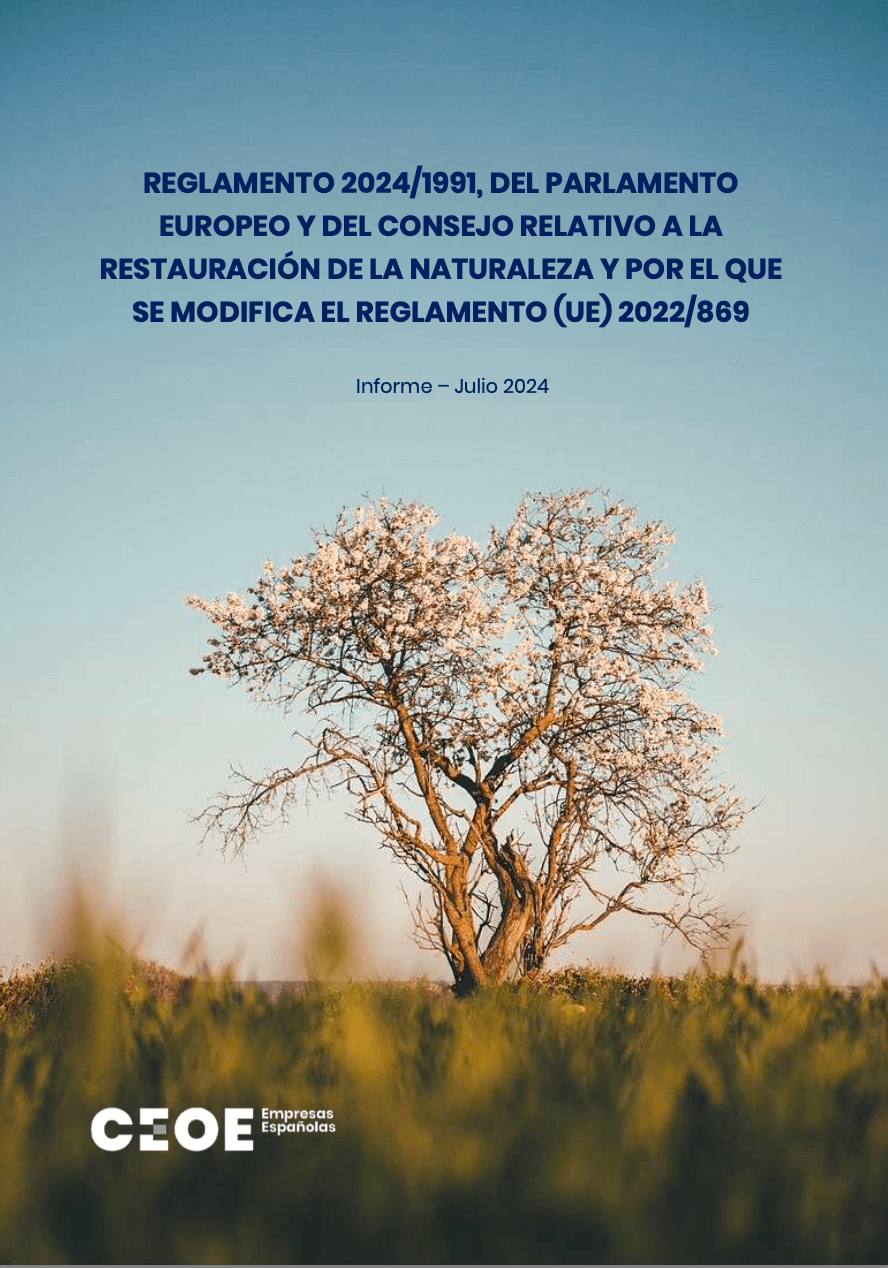
| The CEOE has published a report on Regulation 2024/1991 of the European Parliament and of the Council on nature restoration, which amends Regulation (EU) 2022/869, which addresses, among others, the following key issues: - Background and objective of the regulation. Specifically, this arises from the EU Biodiversity Strategy to 2030 and has as its main objective the recovery of biodiversity-rich and resilient ecosystems in all terrestrial and marine areas of the Member States. - Restoration targets: Sets the target of restoring at least 20% of the EU's land and sea areas by 2030, and all ecosystems in need of restoration by 2050. - National Restoration Plans: Each Member State must draw up a National Restoration Plan to 2050, detailing specific measures for different types of ecosystems. - Target ecosystems: Includes measures for terrestrial, coastal, freshwater, maritime, agricultural, urban and forest ecosystems, as well as for the restoration of pollinator populations and natural river connectivity. - Specific timelines and targets: Sets percentage targets for the restoration of different habitat types in 2030, 2040 and 2050. - Financing and monitoring: Plans should include estimates of funding needs and monitoring systems to assess the effectiveness of the measures. - Exceptions and Flexibility: The regulation allows for certain exceptions and flexibility in the implementation of restoration measures under specific circumstances. |
Recursos relacionados

Integrated Transition Planning: A Short Introduction
Este informe introduce el concepto de planificación integrada de la transición, un enfoque que permite a las empresas alinear clima,…
High-Level Expert Group on scaling up sustainable finance in low- and middle-income countries
Since 2022, emerging markets have experienced the worst capital outflows in their history. The report offers concrete and innovative measures…
2023
Conceptos básicos sobre biodiversidad para preparar a tu empresa para ser positiva para la naturaleza
La plataforma de la UE Business @ Biodiversity organizó un webinario a principios de abril dirigido a organizaciones interesadas en…