

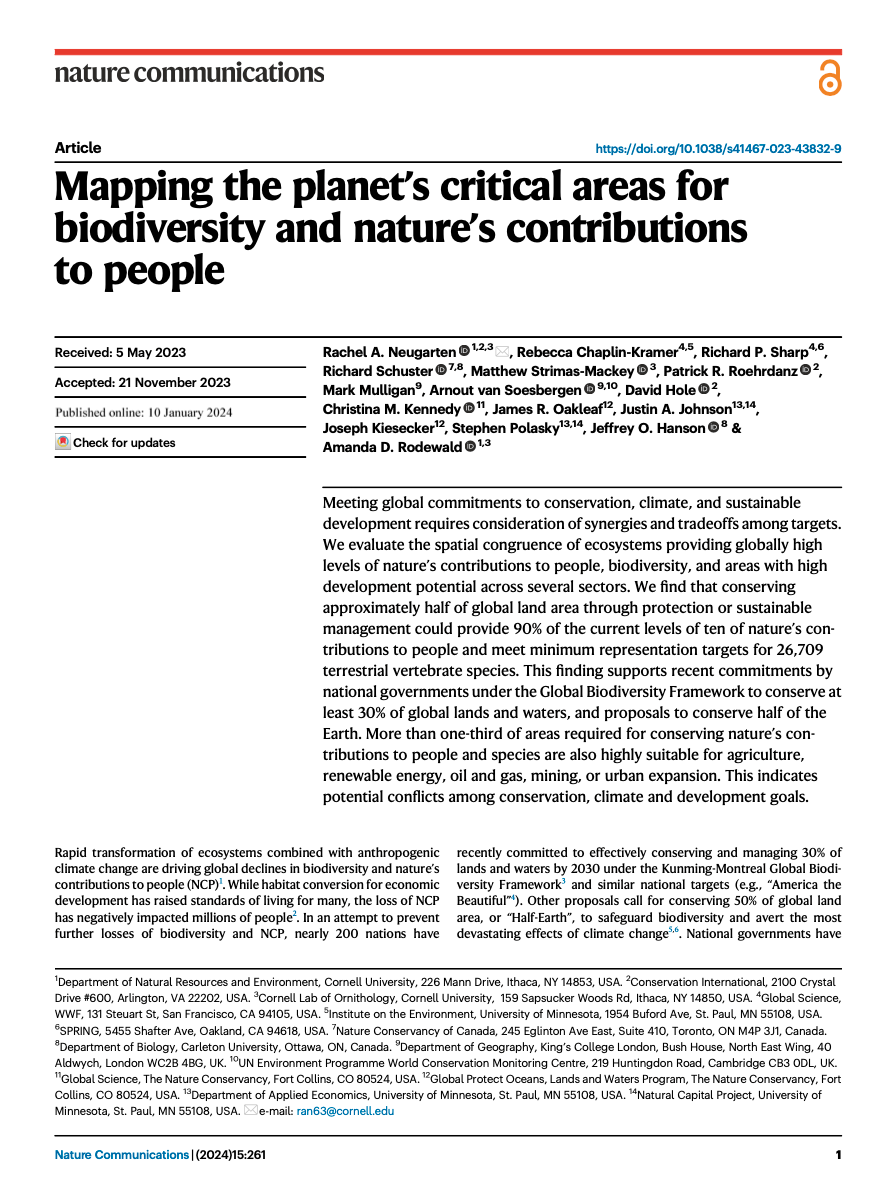
Mapping the planet’s critical areas for biodiversity and nature’s contributions to people
Detalles
| Meeting global conservation, climate and sustainable development commitments requires taking into account synergies and trade-offs between objectives. This research assesses the spatial congruence of ecosystems that globally provide high levels of nature's contributions to people, biodiversity, and areas with high development potential in various sectors. The analysis concludes that conserving approximately half of the world's land surface through protection or sustainable management could provide 90% of the current levels of ten of nature's contributions to people and meet minimum targets for the representation of 26,709 terrestrial vertebrate species. This conclusion supports recent commitments by national governments in the Global Biodiversity Framework to conserve at least 30% of the planet's lands and waters, as well as proposals to conserve half of the Earth. More than a third of the areas needed to conserve nature's contributions to people and species are also well suited for agriculture, renewable energy, oil and gas, mining or urban sprawl. This indicates potential conflicts between conservation, climate, and development goals. |
Recursos relacionados
Developing a Corporate Biodiversity Strategy: A primer for the fashion industry
Biodiversity, the living component of nature, is under threat. World diversity is experiencing a precipitous decline. Businesses and society will…
Measures to Enhance Forest Conservation and Reduce Deforestation. Viewpoints and lessons from
Forests sustain and protect us in a thousand ways, but they are disappearing rapidly. The world has lost 420 million…