

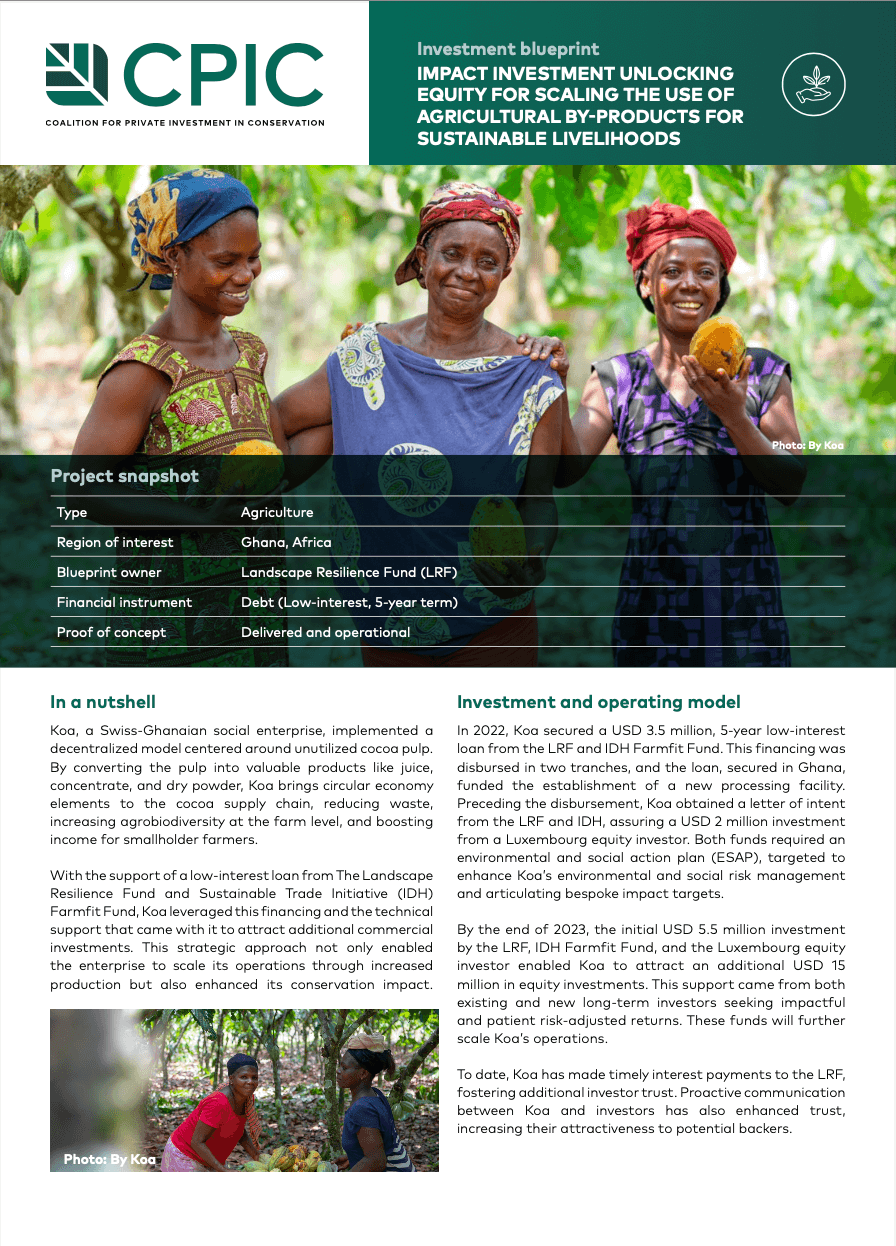
Impact investment unlocking equity for scaling the use of agricultural by-products for sustainable livelihoods
Detalles
Koa, a Swiss-Ghanaian social enterprise, launched a decentralized model focused on unused cocoa pulp. By converting pulp into valuable products such as juice, concentrate and dry powder, Koa brings circular economy elements to the cocoa supply chain, reducing waste, increasing agrobiodiversity on farms and boosting the incomes of smallholder farmers.
Supported by a low-interest loan from the Landscape Resilience Fund and the Sustainable Trade Initiative (IDH) Farmfit Fund, Koa leveraged this financing and accompanying technical support to attract additional business investment. This strategic approach not only allowed the company to expand its operations by increasing production, but also improved its impact on conservation.
Impact measurement
Koa's impact framework, which includes annual tracking and reporting, is aligned with IRIS+, a catalog of performance metrics used by impact investors. Koa's impact framework includes improving the livelihoods of cocoa farmers and their communities, with the aim of reaching 10,000 farmers by 2026, ensuring responsible production without unnecessary harm to people and the planet, and climate-positive cocoa, including insertion and regenerative agriculture. By the end of 2023, smallholder farmers in Koa were managing 3150 hectares of farmland with improved practices. Koa also plans to report on its total restoration and conservation area.
Koa uses GPS mapping and education to address deforestation issues and mitigate exploitation risks in protected areas. The main conservation benefits of Koa's operations include the promotion of sustainable agricultural practices, which lead to increased agrobiodiversity on farms by advocating for the reduction of chemical use, supporting mechanical weeding, and encouraging the use of legumes to improve soil fertility.
In accordance with the ESAP, Koa collaborates with government institutions and traders, following the International Finance Corporation's Performance Standard 6, to prevent habitat and biodiversity loss.
and biodiversity.
Recursos relacionados
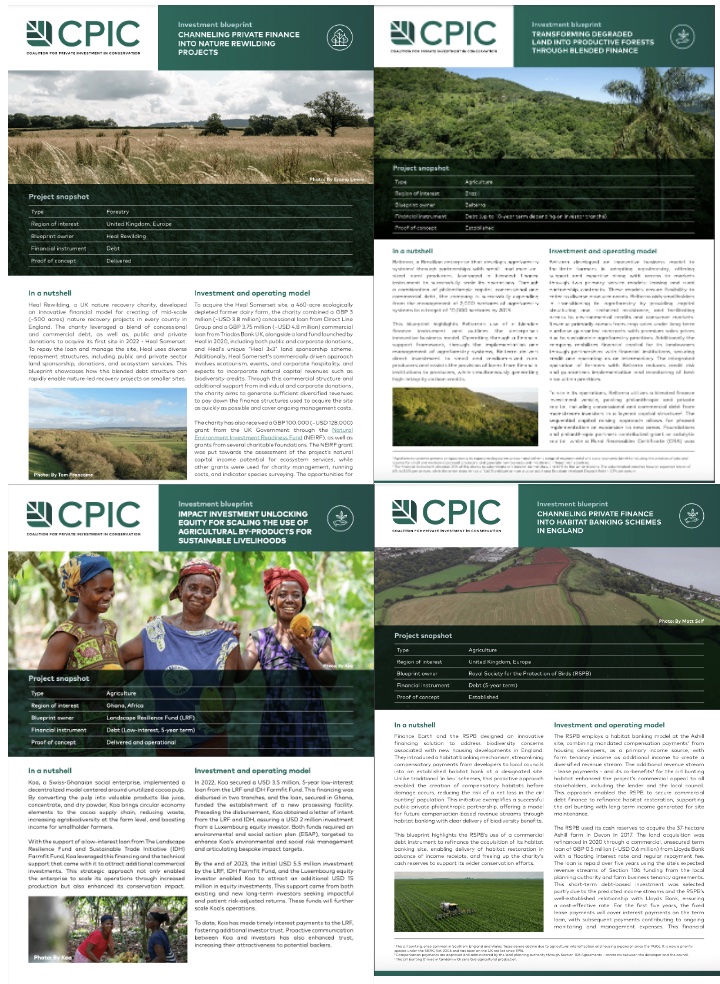
New CPIC Conservation Investment Blueprints: A look a success cases of channeling private finance into agriculture and forestry projects
The business case for economic agents to address conservation and its reciprocal relationship with biodiversity is gaining more and more…
Webinario sobre Nature Positive: casos de estudio
El concepto de naturaleza positiva ha ganado recientemente mucha tracción entre las empresas a nivel mundial con un número creciente…
Why nature-loss is material for central banks and financial supervisors: An introductory briefing on screening for nature-related impacts and opportunities
This report aims to strengthen the understanding by central banks and financial supervisors, including securities regulators, of how they can…