Detalles
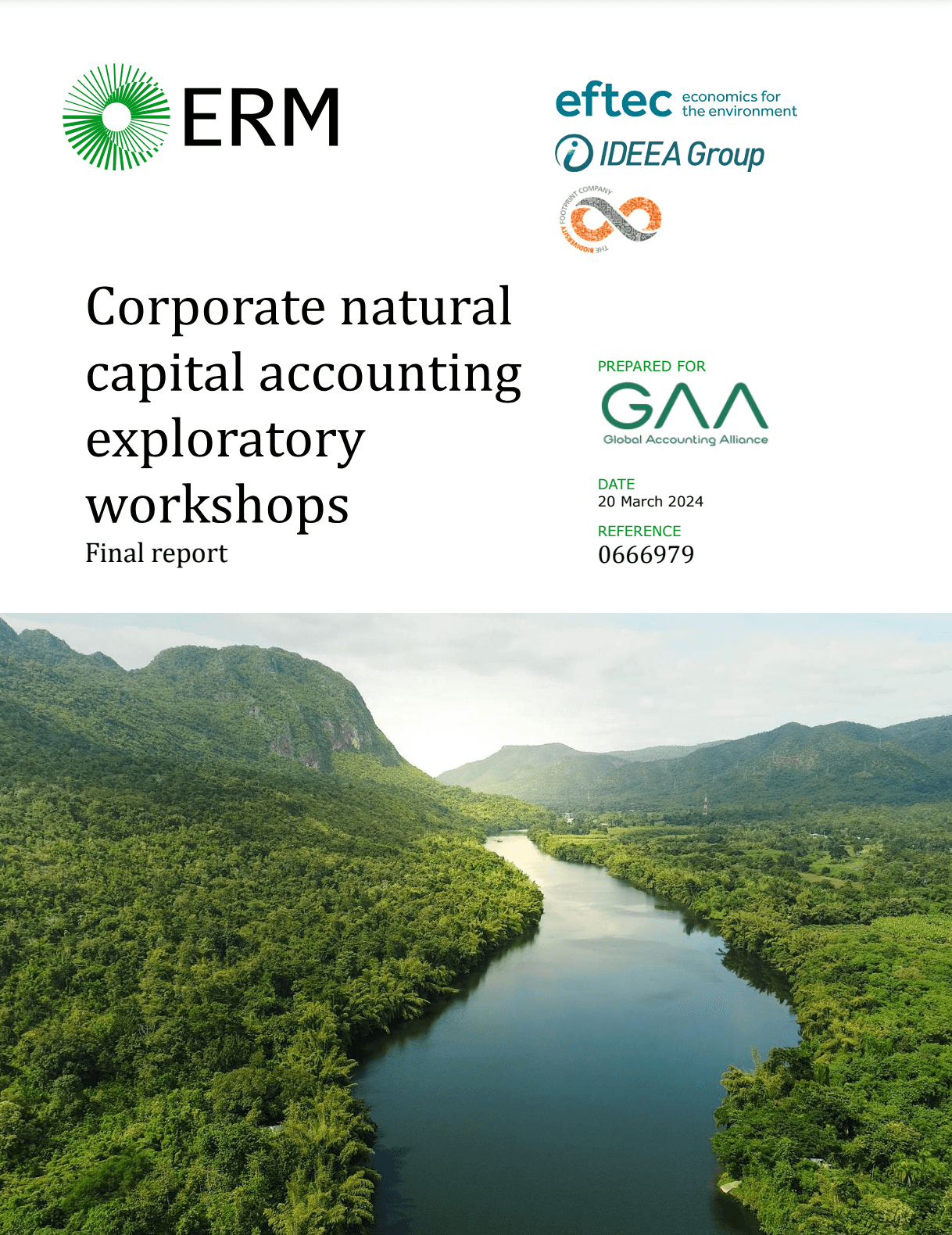
| To help understand the relevance of natural capital accounting (CCN) to accountants' toolkit and to provide input on next steps in relation to how the accounting profession could engage and advance the use of CCN, the Global Accounting Alliance (GAA) hosted a series of workshops with its members and affiliates. This document collects key conclusions and messages derived from these workshops. Specifically, it is based on the Time to Take Stock 2.1 report, which defines natural capital accounting (CNCA) as "the systematic process of identifying, measuring, recording, summarizing, and reporting periodic and cumulative net changes in (a) the biophysical state of natural capital assets and (b) the associated values of natural capital for companies and society at large." This definition is based on the following: · 'An asset inventory in which the biophysical properties and dynamics of each asset category are recognised, · Measurement techniques that use spatially explicit data and apply the principle of ecological equivalence (similar). · Recording rules based on double-entry accounting in financial accounting. · Biophysical states of specific performance and position of the assets. · A scope defined according to organizational and value chain boundaries. The conclusions of the workshops reaffirm the need for a natural capital accounting of companies (CCN) and the central role that the accounting profession has in its development and application. The workshops also identified a number of opportunities, obstacles and progress to advance CCN. The result was a series of recommendations to the GAA to assist its member agencies with the CCN and to make progress in this area. The authors propose seven proposals for standardizations" that provide a general framework to guide the adoption of CCN: 1. Define natural capital as an asset. 2. Develop "stock registers of natural capital assets" using classification systems. 3. Measurement of changes in the state of natural capital. 4. Use of rules for recording accounting facts and related entries (double-entry accounting). 5. Summarize the biophysical state of natural capital with a statement of natural capital position. 6. Summarize the net periodic biophysical changes of natural capital with a statement of natural capital performance. 7. Use valuation or other analytical methods to link stock accounts and integrate. |
Recursos relacionados
Methodology for Eurosif Market Studies on Sustainability-related Investments
This publication includes a new methodology for the preparation of future market studies on sustainability-related investments across Europe. The methodology…
Pathways for measuring biodiversity outcomes of biodiversity credits
The aim of this thematic report is to synthesize the available resources on how to measure biodiversity credits, to check…