

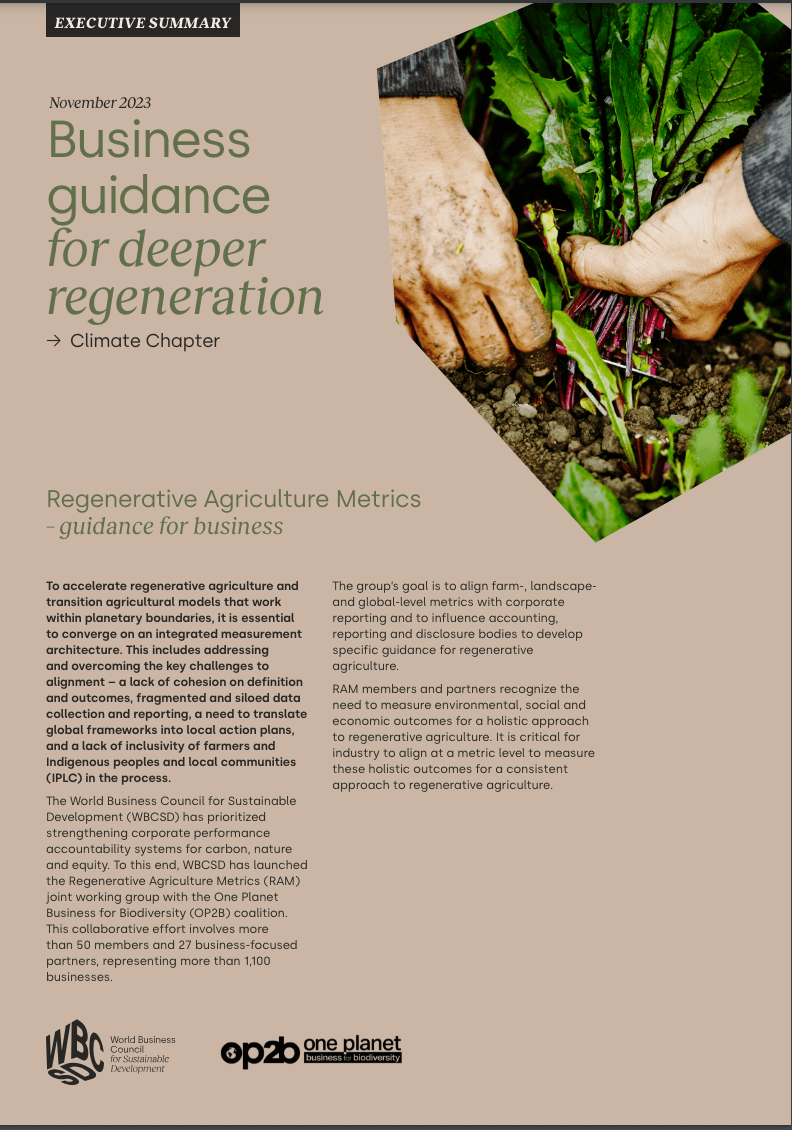
Business guidance for deeper regeneration
Detalles
| To accelerate regenerative agriculture and transitional agricultural models that work within planetary boundaries, converging on an integrated architecture is essential. This includes addressing the main issues of lack of cohesion in definition and outcomes, the collection of fragmented isolated data, the need for global frameworks in local action plans, and the lack of inclusion of farmers, indigenous peoples and local communities (IPLCs) in the process. The World Business Council for Sustainable Development (WBCSD) has prioritized strengthening business performance on carbon, nature, and equity. To this end, the WBCSD has launched the Regenerative Agriculture Metric (RAM), with the One Planet Business for Biodiversity (OP2B) coalition. This collaborative effort involves more than 50 members and 27 partners representing more than 1100 companies. The group's goal is to align farm, landscape, and global metrics with corporate reporting and influence company accounting and accounting, reporting, and outreach bodies to develop specific guidelines for regenerative agriculture. MAR members and partners recognize the need to measure the environmental, social, and economic outcomes of regenerative agriculture. It is critical for the industry to align at a metric level to measure these holistic outcomes for a coherent approach to regenerative agriculture. In line with the growing consensus among regenerative agriculture tools and frameworks, environmental outcomes must have an impact in four areas: soil, biodiversity, water, and climate. MAR members and partners have aligned around regenerative agriculture outcomes and their respective indicators and metrics. This document provides key information related to this approach in the field of climate change. |
Recursos relacionados
EU observatory on deforestation and forest degradation
The Observatory is a non-mandatory, non-exclusive and legally non-binding tool that can support operators, traders and competent authorities of the…
2023
Managing Nature risks: from understanding to action
El análisis de PwC muestra que más de la mitad (55 %) del producto interior bruto (PIB) mundial depende moderada…
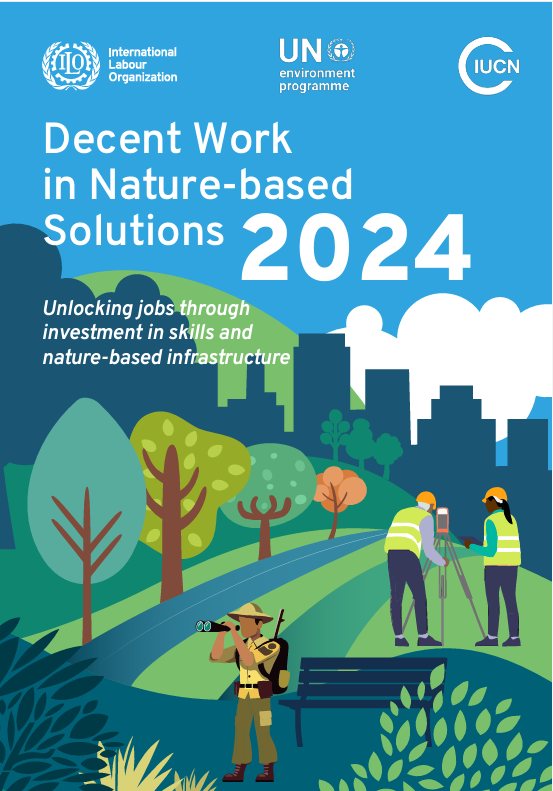
Decent Work in Nature-based Solutions: Unlocking jobs through investment in skills and nature-based infrastructure 2024
The new report by the International Labour Organization (ILO), the International Union for Conservation of Nature (IUCN) and the United…