

Soy and legal compliance in Brazil: Risks and opportunities under the EU deforestation regulation
Detalles
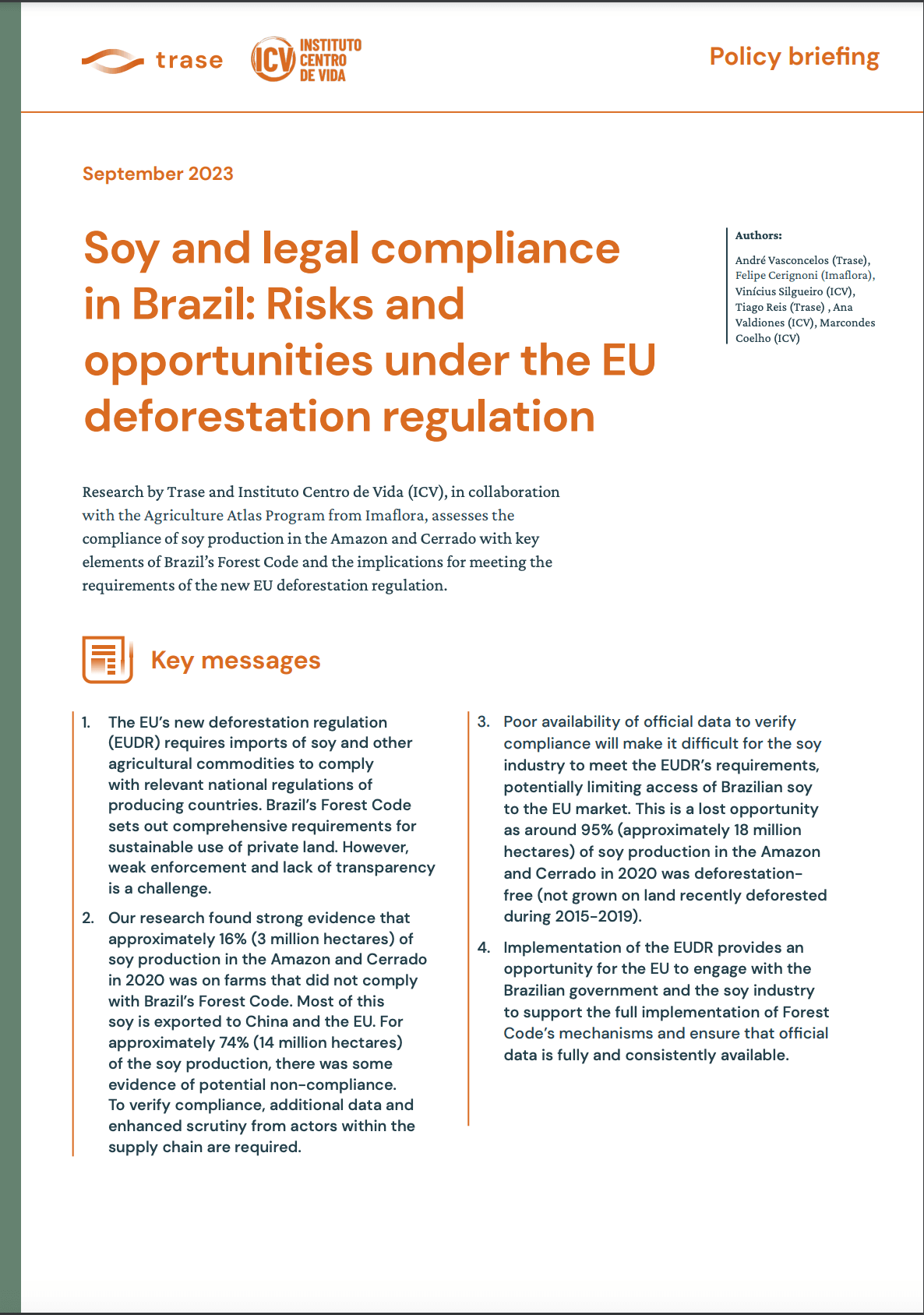
| The new EU regulation on deforestation requires imports of agricultural products to comply with the relevant national regulations of producer countries. How important will this be for importers? This new research published by Trase and ICV shows that, in 2020, 16% of soybeans in the Amazon and Cerrado were produced on farms that did not comply with Brazil's Forest Code. Most of this soybeans were exported to China and the EU. Another 58 percent of the soybeans came from farms that showed signs of possible Forest Code violations, but whose compliance status could not be clarified with publicly available data. Together, this gives a total of 74% of production affected by some evidence of possible non-compliance. These results suggest that traders will face challenges in systematically verifying legal compliance within their supply chains. |
Recursos relacionados

2026
People and nature in UNESCO-designated sites: Global and local contributions
El informe ofrece la primera evaluación global conjunta de los lugares declarados por la UNESCO Patrimonio de la Humanidad, Reservas…
The State of the World’s Forests 2024
Innovation is essential to achieving the 2030 Agenda for Sustainable Development and the Sustainable Development Goals. It is also an…
An Investor’s Guide to Nature and Biodiversity Risks and Impacts
For many investors, the biggest challenge when accounting for biodiversity risk is knowing where to start. Biodiversity loss has many…