

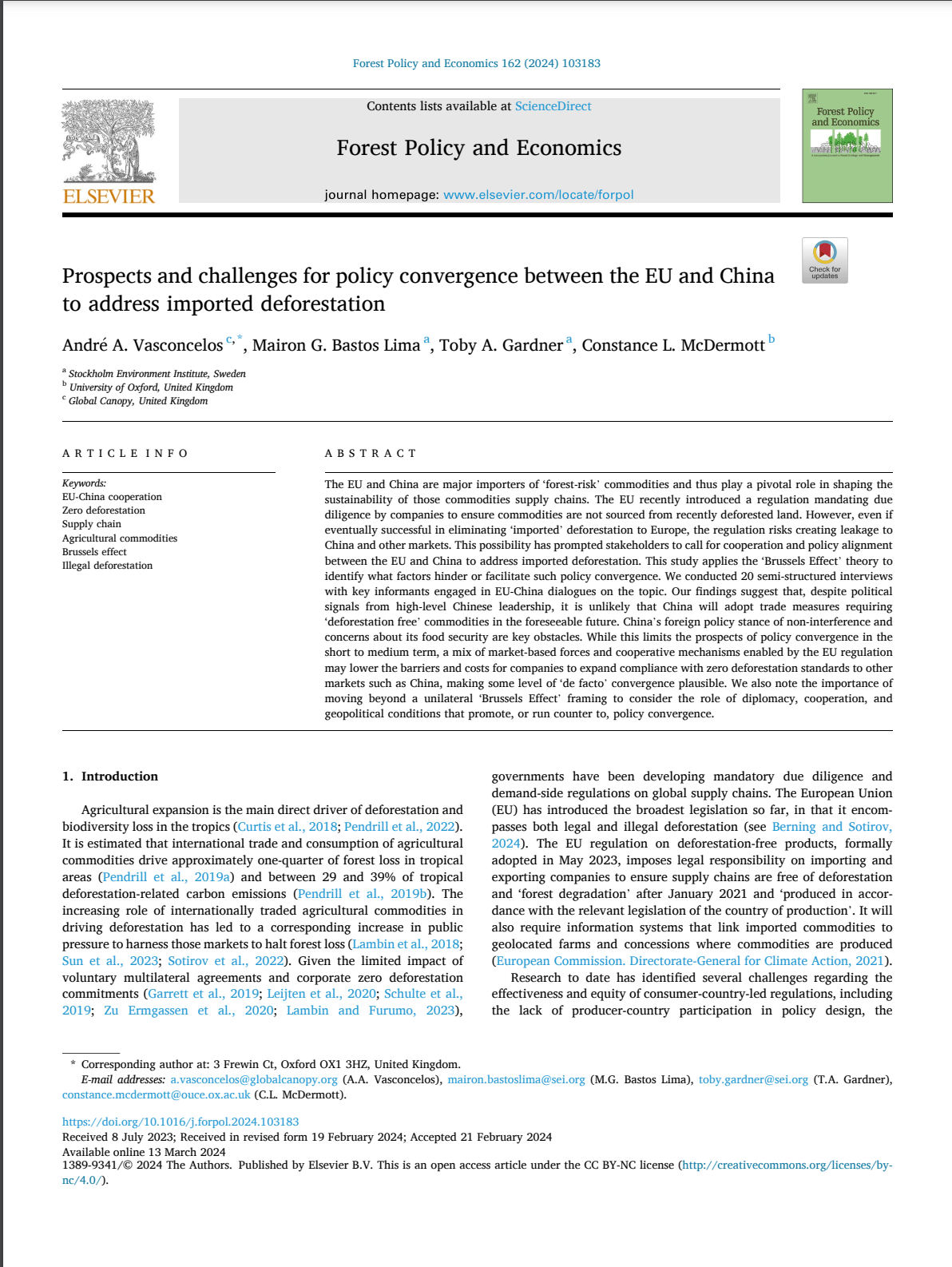
Prospects and challenges for policy convergence between the EU and China to address imported deforestation
Detalles
| China and the EU have a long history of bilateral cooperation on environmental issues. However, there is a gap in the literature on the potential for alignment and synergies of European and Chinese policies and strategies to address imported deforestation. This study helps to fill this gap by developing and expanding the 'Brussels effect' as a framework for analysing the prospects for policy convergence between the EU and China on imported deforestation. The EU and China are the main importers of 'forest risk' raw materials, so they play a key role in the sustainability of their supply chains. The EU has recently introduced a regulation that requires companies to do their due diligence to ensure that raw materials do not come from recently deforested land. However, even if deforestation "imported" to Europe is eventually eliminated, the regulation risks creating leakage to China and other markets. This possibility has led stakeholders to call for cooperation and policy harmonisation between the EU and China to tackle imported deforestation. This study applies the theory of the "Brussels effect" to determine what factors hinder or facilitate such policy convergence. The authors conducted 20 semi-structured interviews with key informants involved in EU-China dialogues on the issue. Their findings suggest that, despite political signals from China's top leaders, China is unlikely to adopt trade measures that require "deforestation-free" raw materials in the near future. China's stance of non-interference in foreign policy and concern for its food security are the main obstacles. While this limits the prospects for policy convergence in the short and medium term, a combination of market-based forces and cooperation mechanisms facilitated by the EU Regulation can reduce barriers and costs for companies to extend compliance with zero-deforestation rules to other markets such as China. making it reach a certain level of "de facto". |
Recursos relacionados

Biodiversity Credits: Unlocking Financial Markets for Nature-Positive Outcomes
Biodiversity credits are an economic instrument that can be used to finance actions that generate measurable positive outcomes for biodiversity…
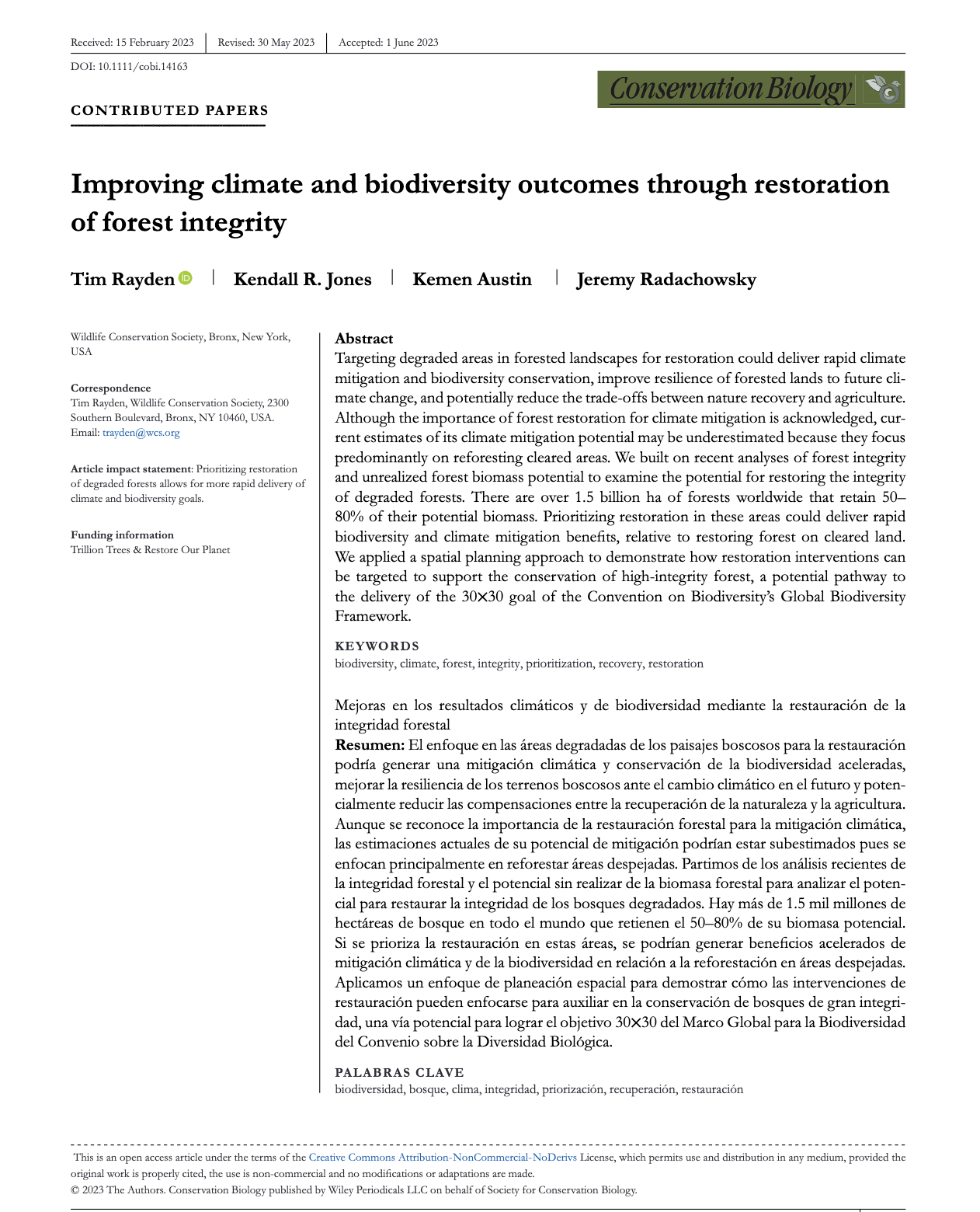
Improving climate and biodiversity outcomes through restoration of forest integrity
This publication maps out the potential restoration zones. Research and practice so far has focused mainly on the reforestation of…
2025
Asking better questions on nature for asset owner chief investment officers
Esta guía puede ayudar a que los directores de inversión (CIO) de entidades gestoras de activos puedan tomar decisiones en…