

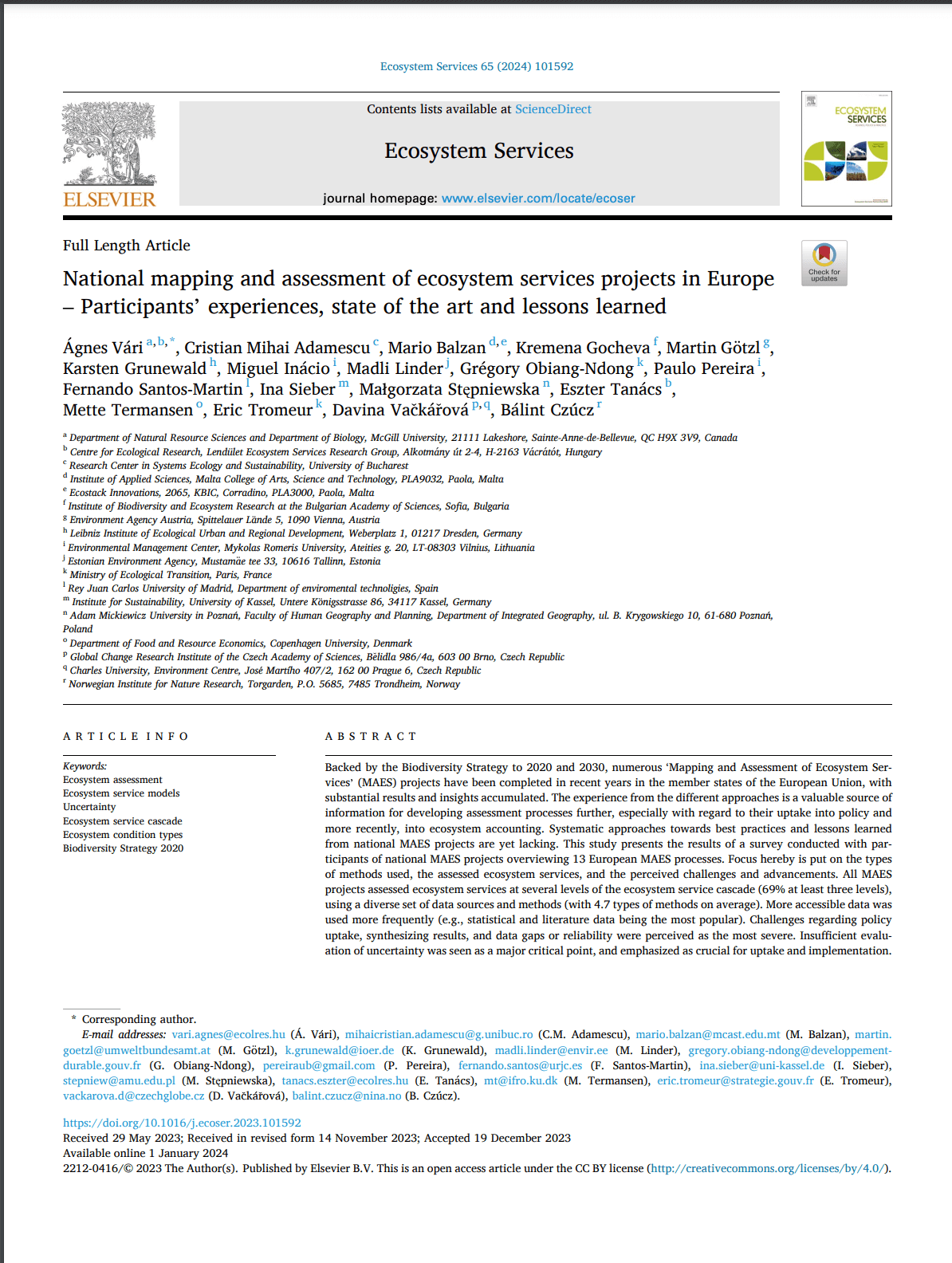
National mapping and assessment of ecosystem services projects in Europe – Participants’ experiences, state of the art and lessons learned
Detalles
| Supported by the Biodiversity Strategy for 2020 and 2030, numerous Mapping and Ecosystem Services Assessment (ESMA) projects have been completed in recent years in the member states of the European Union, with substantial results and knowledge accumulated. The experience of the different approaches is a valuable source of information for further developing assessment processes, especially with regard to their incorporation into policies and, more recently, ecosystem accounting. Systematic approaches to best practices and lessons learned from national MAES projects are still lacking. This study presents the results of a survey conducted with participants of national MAES projects analysing 13 European MAES processes. The focus is on the types of methods used, the ecosystem services assessed, and the challenges and advances perceived. All MAES projects assessed ecosystem services at various levels of the ecosystem services cascade (69% at least three levels), using a diverse set of data sources and methods (with 4.7 types of methods on average). The most accessible data are the ones that were used most frequently (e.g., statistical and bibliographic data are the most popular). Challenges related to policy acceptance, synthesis of results, and data gaps or reliability were perceived as the most severe. Insufficient assessment of uncertainty was considered an important critical point and highlighted as crucial for adoption and implementation. |
Recursos relacionados
Estudio “Horizontes de Financiación e Inversión en Biodiversidad”
El estudio analiza cómo la pérdida de naturaleza se ha convertido en un riesgo sistémico para la economía y el…
Sustainable finance in Spain 2024
The OFISO 2025 Annual Report on Sustainable Financing in Spain in 2024 confirms a growth of 8%, to channel 65,705…
2022
IUCN Restoration Barometer 2022
A partir de los datos presentados por 18 países al Barómetro de Restauración de la UICN de 2021 a 2022,…