

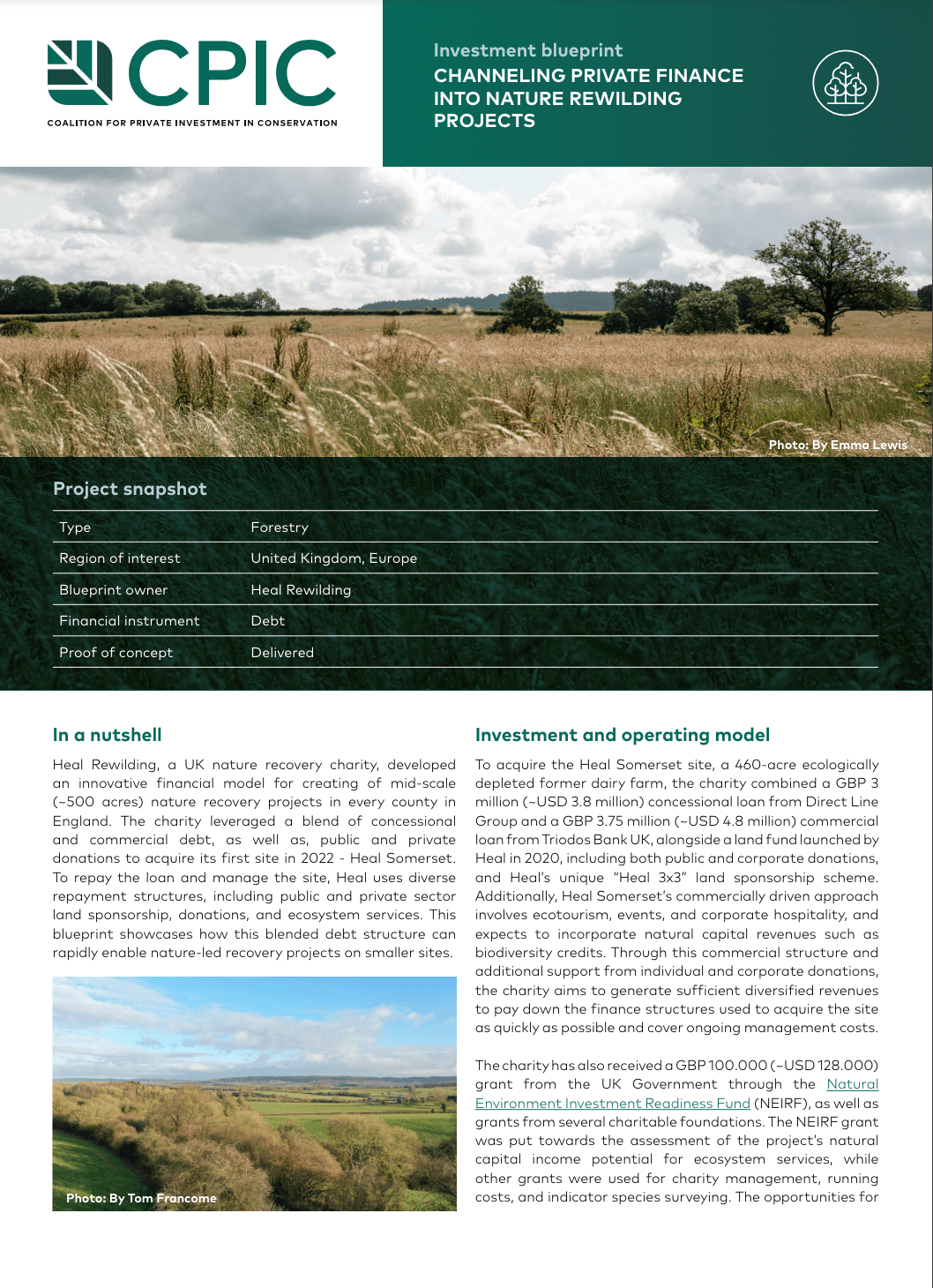
Detalles
Heal Rewilding, a British nature restoration charity, developed an innovative financial model to create medium-scale (about 500 hectares) nature restoration projects in every county in England.
The organization leveraged a combination of commercial and concessional debt, as well as public and private donations, to acquire its first piece of land in 2022: Heal Somerset. To repay the loan and manage the site, Heal uses a variety of repayment structures, including land sponsorship by the public and private sectors, grants, and ecosystem services. This plan shows how this combined debt structure can quickly enable nature-driven recovery projects on smaller sites.
Impact measurement
Since Heal Somerset is a nature restoration project with limited human intervention, it is not possible to set explicit nature return and recovery targets. Despite the absence of an accepted and standardised ecosystem-wide impact framework for nature restoration, covering both habitat and species, Heal used the UK Government's BNG Metric 4.0 to conduct a habitat assessment for the BNG at the site, and is serving as a pilot for baselines and species monitoring in line with the Rewilding Britain framework.
The project has also developed its own tiered approach to species monitoring, with three reference levels of possible species. Some providers that aim to serve voluntary biodiversity markets have frameworks of their own, but until the credit market develops a core framework accepted by the sector, the project will continue to collect data based on a set of metrics in line with the Rewilding Britain framework. For any framework that is established, the project hopes to adapt its impact measurement accordingly. This is likely to include those developed through the British Standards Institution's Investment in Nature Standards Standards Programme.
Recursos relacionados
Ahead of the Curve: A preparatory guide on nature for the agri-food sector
The integration of nature-related risks and opportunities into the strategic planning of companies is increasingly essential, especially in sectors on…
Assessing and acting on nature-related issues: Insights from business case studies in the built environment system
The European Horizon SUSTAIN project – Strengthening Understanding and Strategies of Business to Assess and Integrate Nature – which is…
Discussion paper on Nature transition plans
The mission of the Kunming-Montreal Global Biodiversity Framework (GBF) is to halt and reverse biodiversity loss by 2030, with the…