

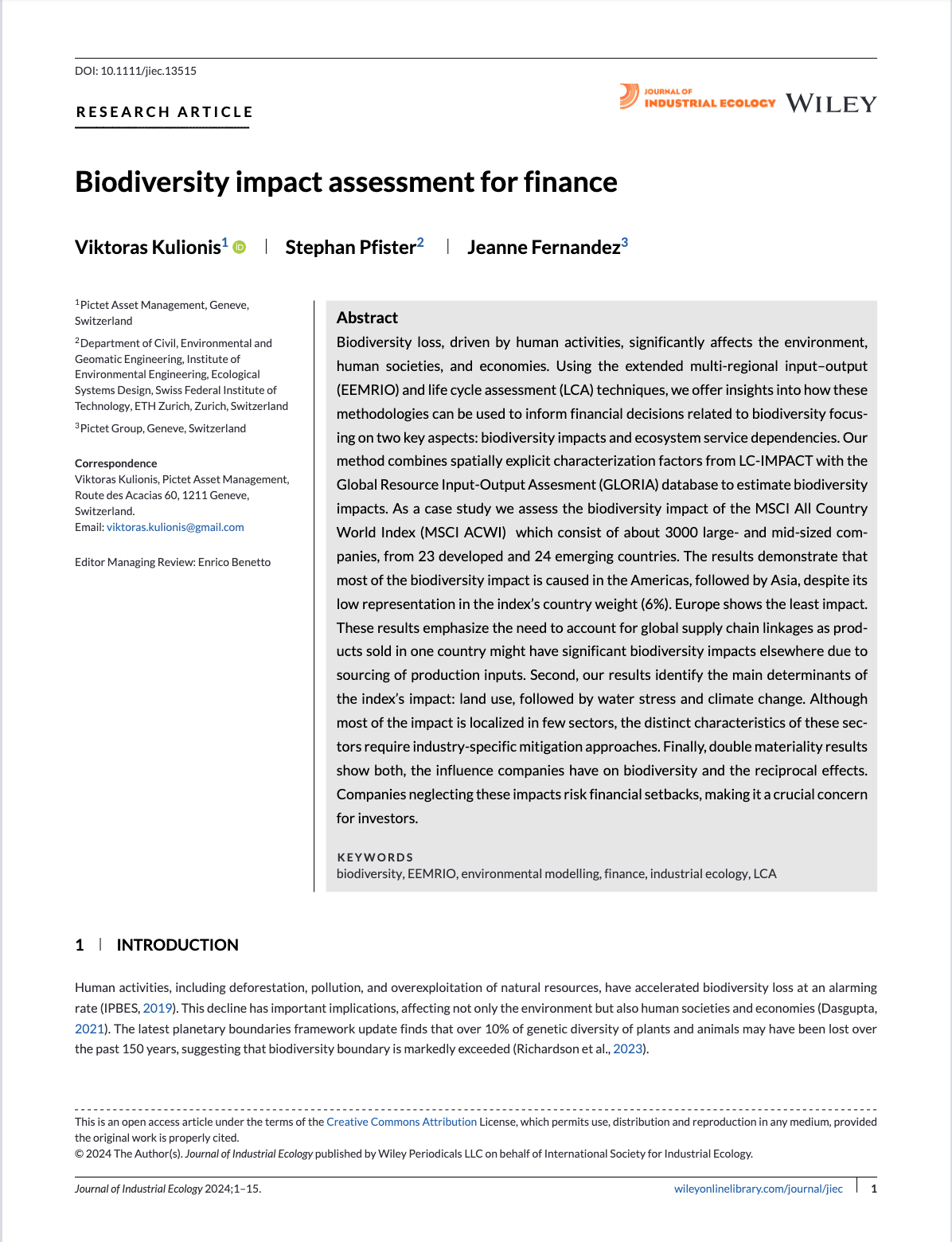
Detalles
| The loss of biodiversity, caused by human activities, significantly affects the environment, human societies and economies. Using the techniques of extended multi-regional input-output (EEMRIO) and life cycle assessment (LCA), the authors of this paper offer an insight into how these methodologies can be used to inform biodiversity-related financing decisions by focusing on two key aspects: impacts on biodiversity and dependencies on ecosystem services. The method used in their research combines spatially explicit characterization factors from LC-IMPACT with the Global Resource Input-Output Assessment (GLORIA) database to estimate impacts on biodiversity. As a case study, the biodiversity impact of the MSCI All Country World Index (MSCI ACWI), composed of some 3000 large and medium-sized companies from 23 developed and 24 emerging countries, is assessed. The results show that most of the impact on biodiversity occurs in the Americas, followed by Asia, despite its low representation in the index's country weighting (6%). Europe shows the least impact. These results underscore the need to take into account global supply chain linkages, as products sold in one country can have significant impacts on biodiversity elsewhere due to the origin of production inputs. Second, the results identify the main determinants of the index's impact: land use, followed by water stress and climate change. Although most of the impact is localized to a few sectors, the distinctive characteristics of these require industry-specific mitigation approaches. Finally, the results of dual materiality show both the influence of companies on biodiversity and the reciprocal effects. Companies that neglect these impacts risk financial setbacks, so this is a crucial concern for investors. |
Recursos relacionados
Frequently asked questions on the implementation of the EU corporate sustainability reporting rules
The European Commission has published a set of Frequently Asked Questions (FAQs) on the Corporate Sustainability Reporting Directive (CSRD).These FAQs…
Nature-Positive Insurance: Evolving Thinking and Practices
Written by the UNEP FI Sustainable Insurance Initiative (PSI) Principles and Nature Teams, this briefing paper articulates the role insurers…
2023
Education session for cross-cutting standard – ESRS 2 General Disclosures
Gemma Sanchez Danes, EFRAG Central PMO lead, dedica esta sesión educacional a profundizar en el borrador 2 sobre divulgación general…