

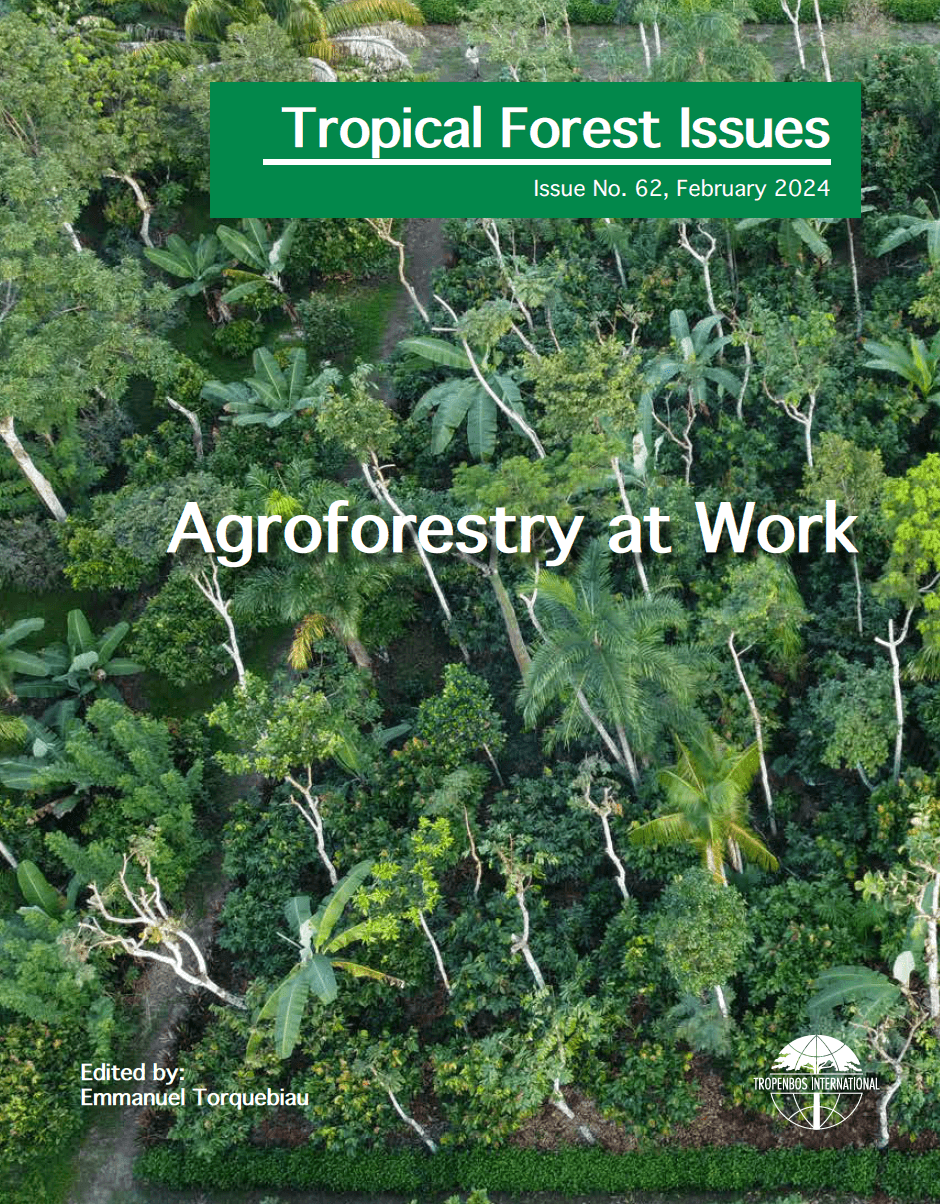
Detalles
| Why are many farmers still reluctant to adopt and expand agroforestry? Are the economic benefits not enough, or are they not perceived as sufficient? Or are there other reasons? These are the questions that were raised when work began on issue 62 of Tropical Forest Issues. This issue contextualizes agroforestry in four introductory articles in terms of economic viability and resilience, gender inclusion, interactions with climate change and biodiversity, and barriers to its adoption. Below are 26 case studies from Africa, Asia and Latin America that show the clear and tangible benefits of adopting agroforestry. These 26 examples of working agro-siliculture from various developing countries demonstrate that agroforestry provides direct and indirect benefits to farming families and the economy at large. Well-documented case studies show that agroforestry "works": it contributes to improved livelihoods (including direct cash income), livelihood activities, employment and other benefits to the community. By highlighting the reasons for its success in various contexts, it is hoped to demonstrate that agroforestry can be extended, encouraging other farmers to develop and scale up more diversified, productive and resilient farming systems. Depending on the local context and individual traditions and perceptions, different farmers will have a preference for different agroforestry practices. This highlights the importance of developing locally owned agroforestry production systems to achieve the full development of sustainable agriculture. |
Recursos relacionados
Dialogue and exchange of experiences on sustainability in the cocoa value chain
The report sets out the challenges and challenges of the cocoa value chain for compliance with the EUDR. Three main…
2023
Standarized Natural Capital Management Accounting
El proyecto Transparent, liderado por Value Balancing Alliance, Capitals Coalition, World Business Council for Sustainable Development (WBCSD) y la Dirección…
Building Synergies Between Climate & Biodiversity Governance: A Primer for COP28
This article discusses the relationship between climate change and biodiversity loss. It provides a summary of the context of the…