

Detalles
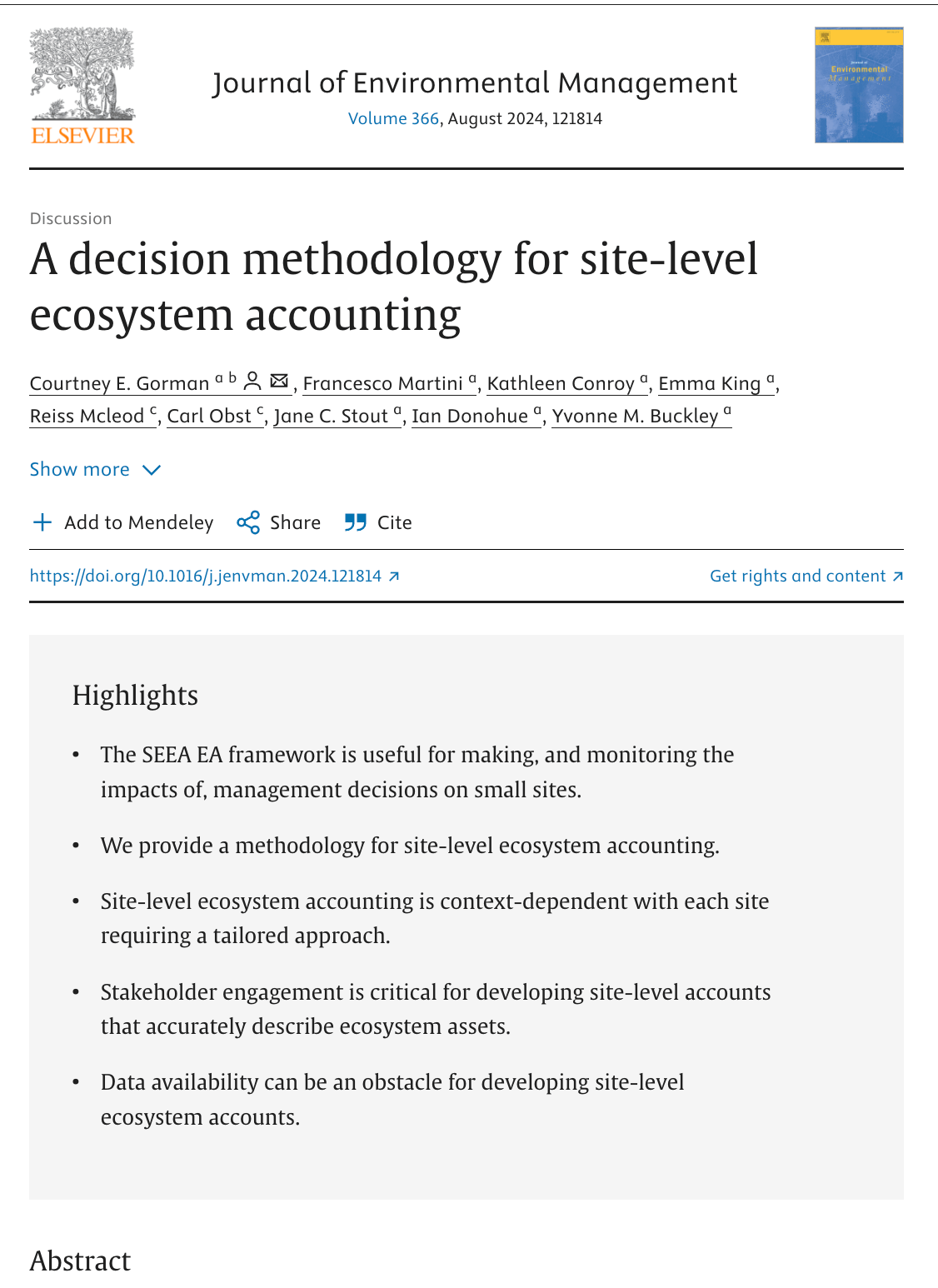
| The United Nations System of Environmental-Economic Accounting (SEEA EA) ecosystem accounting framework is the international standard for ecosystem accounting. To date, the implementation of the SEEA EA has been predominantly carried out on a large scale, usually at the landscape level and at the national level. However, many environmental management decisions are made at the local level, in specific contexts. Although the use of SEEA EA continues to develop at all scales, there is currently no widely supported methodology for its use at local scales, such as the site level. This methodology is used to develop ecosystem accounts at the local scale and describes important decisions at each step of the process. It also offers two case studies that demonstrate the context-dependent nature of the decision-making process of small-scale ecosystem accounting. The two main challenges of site-level accounting are stakeholder engagement and data availability. As the use of SEEA EA continues to increase in policy and decision-making processes around the world, local case studies are needed to adapt this methodology to a wide range of contexts. The examples collected in this publication provide some of the first published examples of the application of the SEEA EA framework at the site level and aim to promote the consistent implementation of ecosystem accounting at all scales. |
Recursos relacionados
A strategic approach on biodiversity: the what, why and how: A summary briefing for business
Companies are increasingly taking steps to integrate the environment, and specifically, biodiversity considerations into their business agendas. To be more…
Biodiversity credits: A guide to support early use with high integrity
This joint report produced by the World Economic Forum and McKinsey & Company Sustainability covers some of the ways in…
From risk to resilience. The business imperative of nature restoration
This report addresses the restoration of Europe's natural habitats, which are deteriorating and where more than 80% are currently languishing…