The IEEB compiles the most relevant aspects for the private sector of the Kunming-Montreal Agreement adopted at COP 15
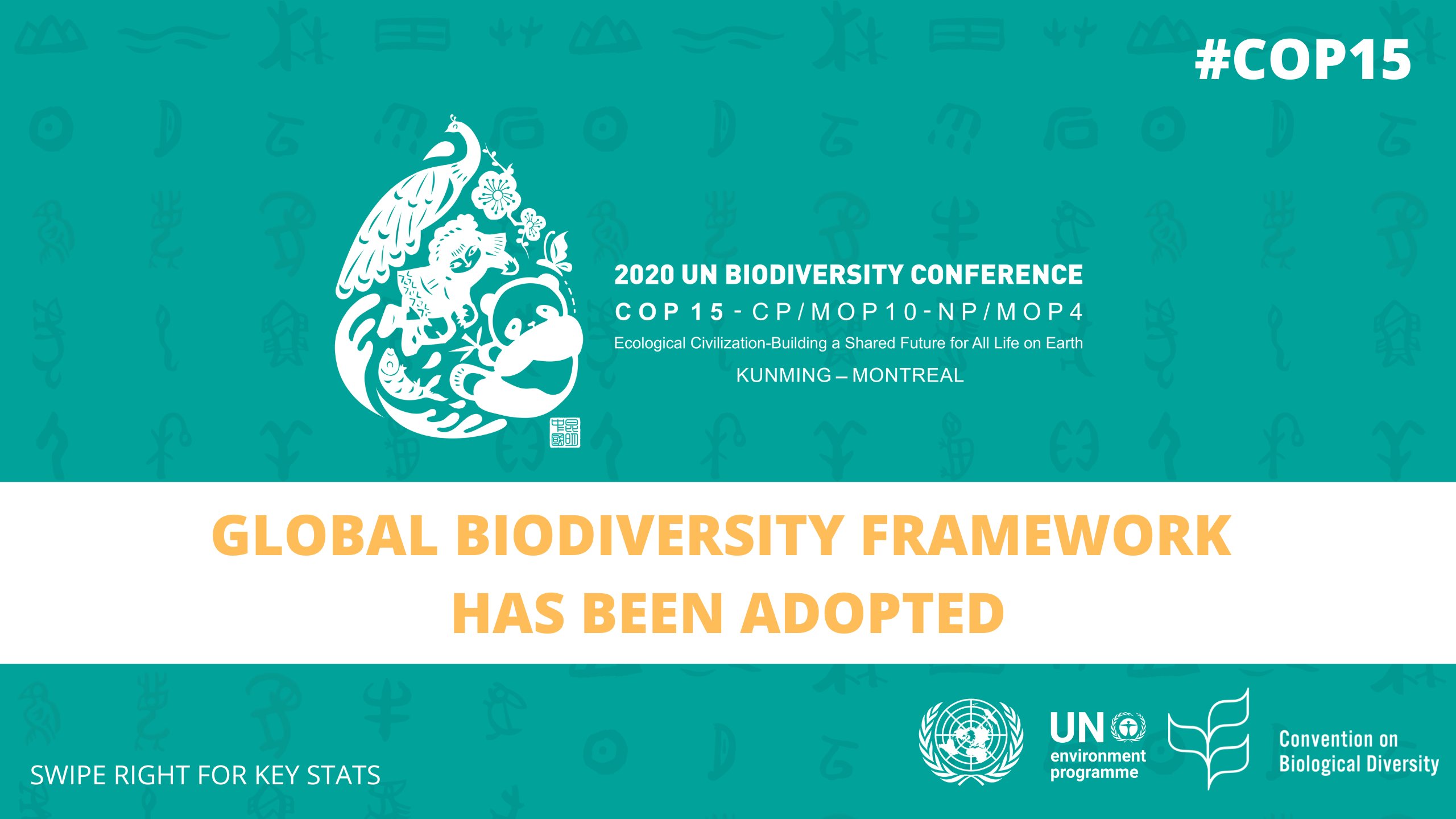
Last December, Montreal, Canada, hosted the UN Biodiversity Conference (COP15), which brought together governments from around the world to agree on a new post-2020 global biodiversity framework. The framework sets out an ambitious plan to transform society’s relationship with biodiversity and ensure that, by 2050, the shared vision of living in harmony with nature is fulfilled. As a result of this international meeting, the Kunming-Montreal Agreement has been adopted, which marks a historic milestone by defining a common goal to reverse the destruction of nature by 2030. Known as
The Spanish Business and Biodiversity Initiative (IEEB) of the Biodiversity Foundation (FB) was represented at COP 15, where the director of the FB, Elena Pita, participated in the annual meeting of the Global Business and Biodiversity Alliance of the CBD Secretariat. The IEEB is part of this alliance and during the meeting the director presented the update of the Initiative, which has been endowed with greater ambition to respond with technical rigor to new legislation, business demands and international trends, favoring greater leadership among the Spanish business sector, to advance in the conservation of biodiversity and natural capital.
At the IEEB we have compiled the aspects of the Kunming-Montreal Agreement that are of particular relevance to the private sector. Thus, it has been established that it is mandatory for all large companies and financial institutions to assess and disclose their risks, impacts and dependencies on biodiversity throughout their operations,
Beyond the negotiations, other relevant initiatives for the private sector were also announced during the course of the conference, including the commitment made by 14 countries, including Spain, to increase their investments by 2025 and mobilise private financial flows in line with the global objective adopted. In addition, the final recommendations of the European project Align, in which the FB participates, were presented to help the private sector know how to measure and value its relationship with biodiversity, facilitating the business and financial sector and other stakeholders to develop standardized natural capital accounting practices, including the development of homogeneous metrics to measure biodiversity.
On the other hand, the Task Force on Nature-related Financial Disclosures (TNDF) has launched beta 3.0 of a harmonized framework for the financial and business sector to report the risks and opportunities linked to their impacts and dependencies on nature. The International Sustainability Standard Board (ISSB) has decided to include, based on the results of the TNDF, key nature-related issues in the development of standards linked to corporate sustainability reporting.
The Accountability Accelerator, developed by the Global Commons Alliance (GCAA), an initiative that aims to help companies account for their commitments to protect and restore nature, and the presentation of the “Roadmaps to Nature Positive” guide developed by the World Business Council for Sustainable Development (WBCSD)), which provides companies with a set of guidelines for assessing, engaging, transforming and being held accountable for how their business contributes to a nature-positive future.
Finally, Nature Action 100 has presented a new initiative aimed at investors to promote the assessment of risks and dependencies of nature.
Undoubtedly, the new Global Biodiversity Framework will accelerate the transformation of socio-economic systems and reward nature-positive actions, opening up a range of opportunities for companies and financial institutions, and from the IEEB we will continue to support this paradigm shift and accompany companies in this new scenario.