

Natural capital approaches: shifting the UN Decade onEcosystem Restoration from aspiration to reality
Detalles
| The UN Decade on Ecosystem Restoration offers a vital opportunity to advance integrated, larger-scale approaches that reverse ecosystem degradation, biodiversity loss, and climate disruption and deterioration. Combining tools from different disciplines is essential to address these intertwined global crises through inclusive and equitable strategies with demonstrable socio-economic benefits. The tools and initiatives described here, such as the EcoHealth network, the System of Environmental Economic Accounting (SEEA EA) and its implementation through the INCASE project in Ireland, and the Natural Capital Project, present ready-made approaches to engage with policymakers and stakeholders in a transparent way. These examples are working to obtain accurate indicators that reveal the true costs and benefits of restoration policies and projects in both environmental and social terms. Of note, collaborative efforts, including engagement between environmentalists, economists and other stakeholders, are essential to inform the ongoing development of fit-for-purpose approaches to natural capital, and that synergies between natural capital and restoration approaches can be further strengthened to increase awareness and progress of restoration projects at the scale envisaged by the United Nations Decade for Conservation of Rural Development. Ecosystem Restoration. The paper also reflects on the term "natural capital," which is often misunderstood because it implies that monetary metrics should take precedence over non-monetary arguments or considerations, posing a barrier to engagement for some environmentalists, environmentalists, and stakeholders. Natural capital-based approaches offer us the opportunity to follow and support the changes needed to scale up and integrate the culture of restoration into decision-making across sectors, highlighting the multiple benefits to society and the economy. |
Recursos relacionados

EUDR compliance: Understanding your position in beef, cocoa, coffee, palm oil, rubber, soy, and wood supply chains
The EU Regulation on Deforestation-Free Products (EU Regulation 2023/1115), introduces obligations for operators and traders in relation to the placing…
State of Nature and Climate 2025 Centre for Nature and Climate
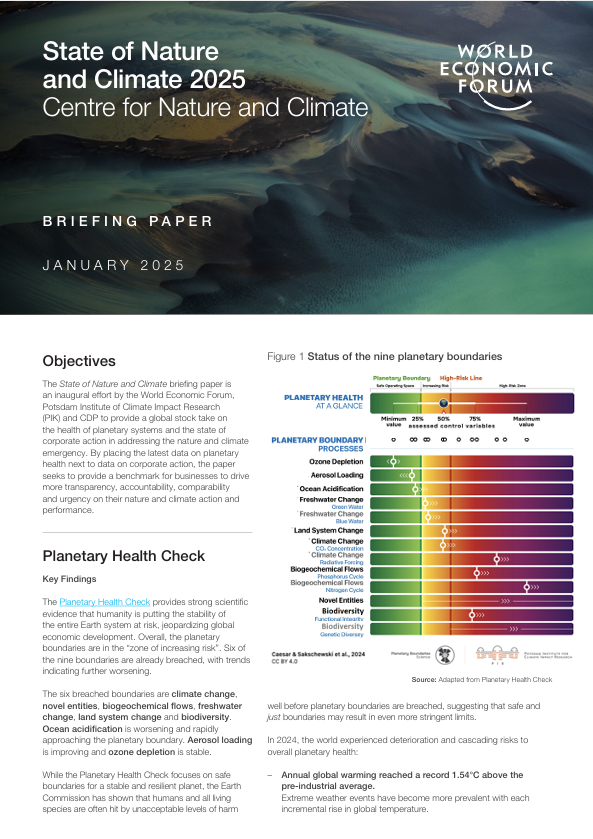
In this report, the World Economic Forum, the Potsdam Institute for Climate Impact Research (PIK) and CDP take a global…

Beyond Rhetoric: A Call for Equivalency Rules for Biodiversity Credits
Biodiversity credits will be used to counteract negative impacts and will be integrated into business trajectories of net positive impacts…