

Detalles
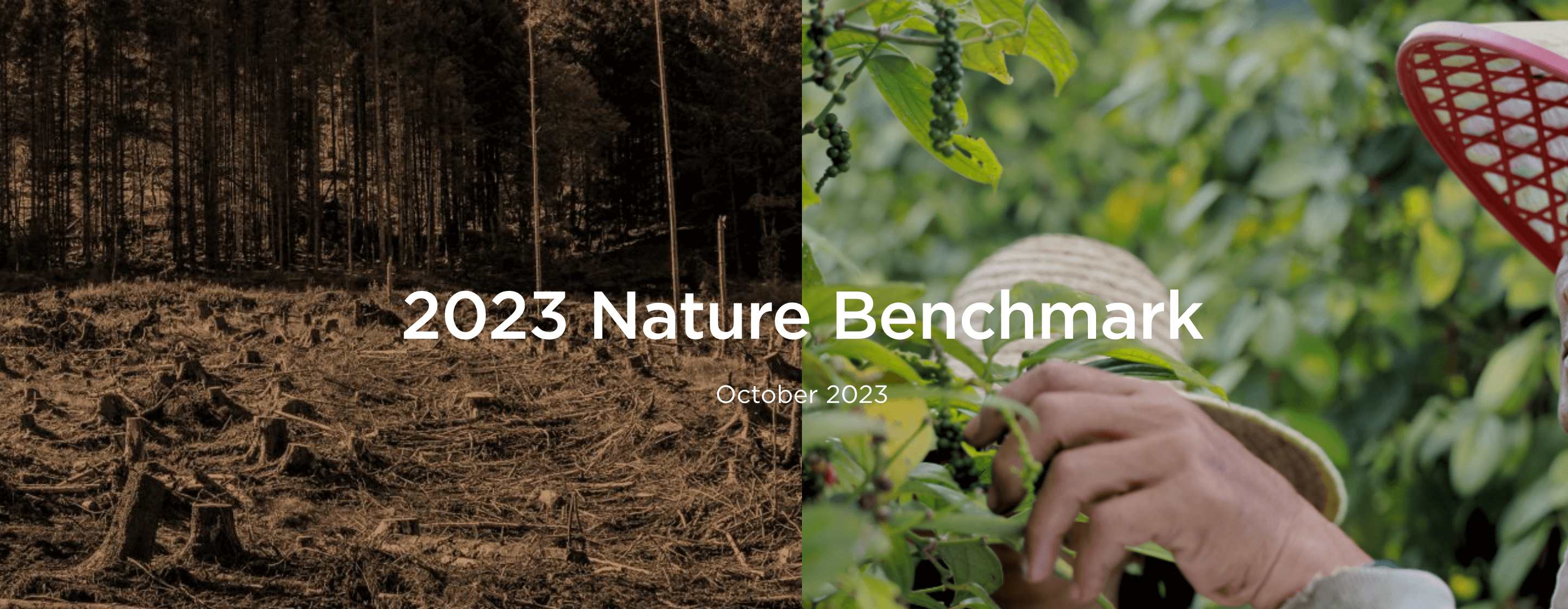
The 2023 version of Nature Benchmark evaluates 350 companies from the entire food and agricultural value chain and 30 companies from the paper and forestry industry. These food and agriculture companies account for more than half of global food and agriculture revenues.
The results of the Nature Benchmark 2023 show that:
- While some companies are taking important steps to transition to sustainable production, the vast majority still don't really understand how they affect nature and how they depend on it.
- Companies are failing to disclose their impacts and dependencies on nature.
- Almost half of the companies analysed have climate commitments. But to reach net-zero emissions by 2050, commodity-driven deforestation must be ended by 2025. By eliminating deforestation, conversion, and associated human rights abuses from their supply chains, food system companies can make significant progress on climate change, biodiversity, and social issues.
- Only 12% of companies commit to respecting the right of access to water, sanitation and hygiene, which is crucial for people's well-being and dignity. This is a missed opportunity, as defending environmental rights not only benefits communities and businesses, but also the ecosystems of which they are a part, especially in the global south. Companies should recognize environmental rights as essential human rights and incorporate them into their identification processes.
- Around 30% of companies report reductions in water use or disclose water use in water-stressed areas, suggesting a growing awareness of their role in ensuring water availability around the world. However, water scarcity is about more than just reducing water use: it's also about the quality of water available for essential human needs like drinking and bathing. Only 12% of companies report metrics on pollutants discharged, and only 2% have set targets to reduce them.
- Ceres' Corporate Expectations for Water Valuation and SBTN's Freshwater Goals provide comprehensive guidance and expectations for sustainable water management for businesses.
- Worryingly, only 28% of food companies consistently report on how they are meeting the targets they set for themselves, a figure that is almost half behind other industries. Companies that demonstrate strong corporate governance score significantly better on other sustainability issues. Therefore, to enable impact, companies must prioritize the development of a sustainability strategy that covers nature, supported by concrete high-level responsibility to implement the strategy.
Recursos relacionados
Measures to Enhance Forest Conservation and Reduce Deforestation. Viewpoints and lessons from producing countries
Forests sustain and protect us in a thousand ways, but they are disappearing rapidly. The world has lost 420 million…
Guidelines on the names of funds that use the term ESG or sustainability-related terms Guidelines on the names of funds that use the term ESG or sustainability-related terms
ESMA has published the translation of its Guidelines on the use of ESG and sustainability-related terms in fund names. The…
Positive incentives for Ibero-America and exchange of best practices
This event took place within the framework of COP16 of the Convention on Biological Diversity in Cali (Colombia), and was…