

Frequently asked questions on the implementation of the EU corporate sustainability reporting rules
Detalles
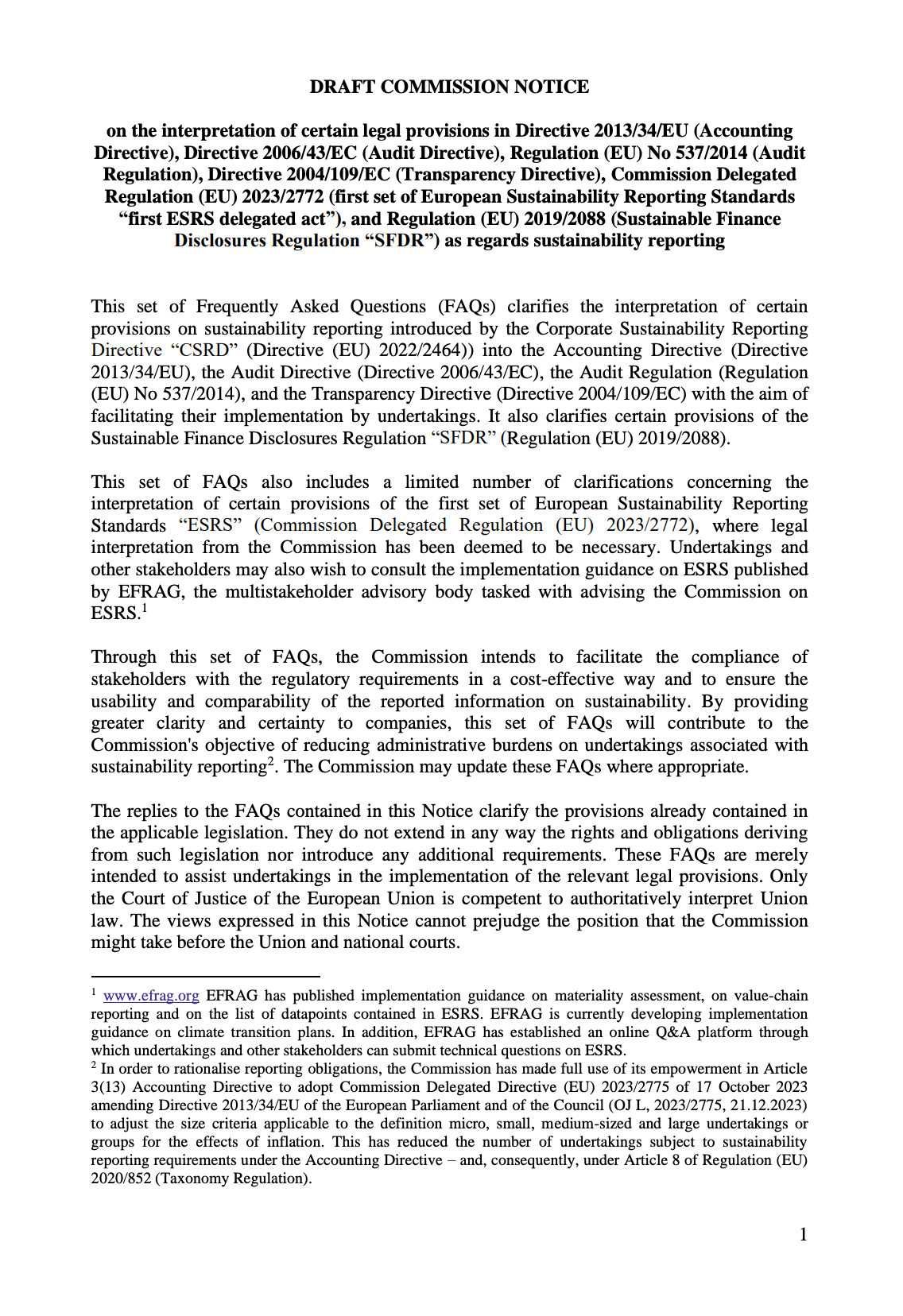
| The European Commission has published a set of Frequently Asked Questions (FAQs) on the Corporate Sustainability Reporting Directive (CSRD). These FAQs provide essential insights and clarifications, helping organizations across Europe better understand and comply with CSRD requirements. This resource is particularly valuable for EMAS-registered organisations as they navigate the evolving landscape of sustainability reporting. This resource also includes a limited number of clarifications on the interpretation of certain provisions of the first set of European Sustainability Reporting Standards (ESRS) (Commission Delegated Regulation (EU) 2023/2772), where legal interpretation by the Commission has been deemed necessary. Companies and other stakeholders can also consult the implementation guide on ESRS published by EFRAG, the multilateral advisory body tasked with advising the Commission on ESRS. These FAQs provide essential insights and clarifications, helping organizations across Europe better understand and comply with CSRD requirements. This resource is particularly valuable for EMAS-registered organisations as they navigate the evolving landscape of sustainability reporting. |
Recursos relacionados
Nature Action 100 Company Benchmark Indicators
The Nature Action 100 initiative, the first global investment community-driven commitment to nature and biodiversity loss, has revealed a series…
CSRD: A Guide to the Physical Risk Requirements
This document is a comprehensive guide that explains and simplifies the physical risk requirements of the Corporate Sustainability Reporting Directive…
Platform’s Workstream Finance Workshop series: Financial institutions explore approaches to assess positive biodiversity impact
Between April and June 2025, a series of online workshops were held organised by the EU Business and Biodiversity Platform…